CNN-IBN Sports Editor Gaurav Kalra takes a close look at 20 years of Tendulkar.
For my generation (the one that has traversed teenage to early 30s!),Sachin Tendulkar has been a constant indulgence. When he arrived a Prime Minister had forced us consider our caste. Mobile phones were still part of sci-fi flicks. An unspectacular life in government service was what we were taught to aspire for. News was still not a 24-hour circus.
Amitabh Bachchan was frittering away a body of awe-inspiring work with a series of monstrosities. A lap-top was a grainy adult film the video shop shop owner quietly slipped into your palm as adolosence demanded its price.
So much has changed, yet there is one constant. The indulgence that assures you to this day that it doesn't need to be forsaken. Sachin Tendulkar. Memories are vivid. And we remain fulfilled, yet unsatiated. To indulge myself a bit more, I decided to pick one Tendulkar moment from each year that he has been an Indian cricketer. Much like choosing just one piece of chocolate from a scrumptuous box, this is a hard task. But indulgence demands its price! So here we go with my top 20 Tendulkar moments; One from each year:
1989
The Test matches from Pakistan weren't broadcast live so we only read tales of a fearless debut. When he brushed away a blow to the nose from a beastly Waqar Younis bouncer to bat on. The moment that remains etched in memory is from an exhibition one-day game. Abdul Qadir, that magical leg-spinner, dancing in to the boy. And being clouted for six after six. Tendulkar's captain, no mean hitter of the cricket ball himself, is watching flabbergasted from the non-striker's end. A stunned crowd is silent. I can't recall the result of the game. But in the space of a few balls, the first sign of Tendulkar's genius was apparent.
1990
At Manchester, England have set India an unachievable 408 in the final innings. At 127 for 5 with Sidhu, Shastri, Manjrekar, Vengsarkar and Azhar dismissed the result stinks of inevitability. Tendulkar has just turned 18 and so finally has a driving licence! But on this day he doesn't just drive! He cuts, pulls, glides and confounds his team to the safety of an unexpected draw. It is his first Test century. We are learning to rely on Tendulkar.
1991
A quiet year. India play only two test matches and a smattering of one-day cricket. Tendulkar achieves little in those. But as the year is ending a tour to Australia begins. India are thrashed first at Brisbane by 10 wickets and then at Melbourne by 8 wickets. In the second innings at the MCG, Tendulkar makes 40. The second highest individual score for India in the innings. It is in his dismissal that clues to a growing reputation are visible. Allan Border, Australia's usually stoic captain, holds on to a skyer and leads a wild celebration. Hmmm, Australia were winning anyway, and comfortably at that. So why this? Is the teenager already the most prized wicket in the Indian line-up?
1992
The seminal hundred at Perth against an Aussie attack hurling more than just five and a half ounces of leather at him was for many the making of Tendulkar. My abiding memory from this year though is from a miserable day in Wellington during the World cup. India are being thrashed by West Indies. Tendulkar makes just 4 and gets carted for 20 in 3 unimpressive overs. But as Phil Simmons launches one into orbit off Prabhakar, and it swerves and hisses in the cold Wellington air, somehow one felt assured that Sachin was under it. He catches it, hits his head on the turf and is forced to walk off the field. In nearly every game we start to learn, there is a Sachin Tendulkar moment.
1993
Hero cup Semi-Final vs South Africa. 6 are needed to end India's tournament in the final over. In front of a packed Eden Gardens, with the cacophony only Calcutta can achieve. Kapil Dev, Javagal Srinath and Manoj Prabhakar; all have overs left. Skipper Azhar takes an incredible punt. Calls Tendulkar on to bowl his only over of the game. The 21 year old calmly steps up and concedes just 3. India win. Any lingering doubts about who India's turn to man in a crisis is are laid to rest.
1994
Navjot Sidhu wakes up with a stiff neck in Auckland. India search for a replacement opener. "Let me do it", Tendulkar is reported to have urged Azhar. Chasing just 143, Tendulkar sets the ground ablaze. 82 are made in 49 balls. 15 fours and 2 sixes. India win in the 24th over. The first step has been taken towards a one-day career that will scale peaks generations will be in awe of. Sachin Tendulkar remains India's opener in one-day cricket to this day, 15 years later.
1995
India only play three forgettable Tests that year against New Zealand at home. One-Day cricket is the new money spinner and Sachin starts to make that stage his own. In Sharjah comes another full throttle assault. Chasing just a shade over 200, Tendulkar lets the emerging Sri Lankan outfit that would be crowned World Campions in a year have a taste of his new found love for brutalising the new ball. 112 in 107 balls, the world is starting to fear the ferocity of Tendulkar.
1996
On his second tour to England, Tendulkar arrives as the world's most followed batsman. And it is in the final Test of the series that sees the emergence of his great batting contemporaries, Sourav Ganguly and Rahul Dravid that Sachin plays his signature knock. 177 in the first innings, batting for 6 hours to help India post a massive 521. And 74 in the second in a mediocre team score of 211. The Test match is drawn, the series is lost, but Tendulkar is now a reliable bank of runs. We realise that in every series he sets goals for himself, and inevitably achieves them as only geniuses can.
1997
Its his first coming as captain. And the man he deposed in the job is his partner as a session of Test cricket unfolds in Cape Town that staggers to this day. South Africa have made 529. India are on a timid on 58 for 5. When Tendulkar in the company of Azhar suddenly counter-attacks. Centuries flow from their blades at the speed of light. The home team wins in the end, yet remain bedazzled by what had unfolded. When asked later what the plan was, Tendulkar innocently replied, "We were concentrating on the singles!"
1998
Desert Storm. It is the week he turns 26 in. Captaincy has returned to Azhar. In the space of a couple of days, Tendulkar plays the most compelling one-day innings in living memory in Sharjah. First, he makes 143 to carry India into the final. And then in the summit clash, as India chase down 273, Tendulkar hammers 134 in 131 balls. 12 fours and 3 sixes. This was the signature moment that underlined his dominance of the world's most dominant team. Now there is Tendulkar...and then there are the rest in the hierarchy of batsmen around the world.
1999
India's world cup campaign is woefully off-track in England. But Tendulkar is shattered by a greater and irrepairable loss. His father passes away in Mumbai. Tendulkar flies home. And then, finds the courage to leave a grieving mother and family behind to take a long flight back to England. Tendulkar joins his team at Bristol and walks into bat with against Kenya. A hundred was ordained by the gods. Moist eyed, we applaud as a Sachin we can't comfort, looks heavenwards for a heart-wrenching private moment with the man he still calls his role model. Ramesh Tendulkar would have been proud. We were just grateful that in this lifetime, there was Tendulkar.
2000
Sachin is captain again. But as the ghost of match-fixing threatens lurks menacingly, India face a well oiled South African attack on a spicy pitch at Mumbai. In the first innings, Tendulkar makes a divine 97 out of India's 225 against Donald, Pollock, Klusener and Kallis. The ungrateful in the stands shamefully boo him as India ultimately lose. And would lose the series. But there remains little doubt that captain or not, Tendulkar won't be matched when battles against rampaging fast bowlers are thrust upon us. Even when all was lost, there was Tendulkar.
2001
Its the first Test of a series against South Africa in Bloemfontein. Expectedly, India are quickly tottering on 68 for 4. Tendulkar is joined by a man who by his own admission only began playing the game after watching the master on television. His name is Virender Sehwag and he is on debut. In a delicious fairytale, both men reel off attractive hundreds and add 220. Tendulkar, we already knew was an inspiration to many. Just how deeply ingrained he was in the bloodstream of emerging India's young cricketers was now clear as day.
2002
Tendulkar arrives in England for his third test series. He has never been part of a team that has won a Test match in the country of the game's origin. At Headingley, that opportunity arises. India play 5 bowlers. And bat first in helpful bowling conditions at Headlingley. Dravid makes 148. Ganguly makes 128. Tendulkar, a small matter of 193. India have 628 on the board. Kumble takes 7 wickets. India win by an innings. Tendulkar is no longer a lone ranger. He relishes sharing centre-stage with cricketers of unmistakable pedigree. In the company of great men, the sparkle of Tendulkar is enhanced further.
2003
At Centurion, India are playing Pakistan in a World Cup league game. It is the first face-off between the rivals in nearly 3 years. Pakistan have made 273 batting first. And to defend it have an attack that answers to the names Wasim Akram, Waqar Younis and Shoaib Akhtar. Sachin makes 98 in 75 balls. India win. Enough said.
2004
The new year brings a wave of doubt. India have punched above their weight in Australia. The series is level 1-1. But Tendulkar's blade has fallen silent. Are his powers waning? Is their a chink in the armour? Sachin steps out to bat at Sydney with India at 128 for 2. When the innings is declared, India are 705 for 7. Tendulkar is unbeaten on 241. He has batted for over 10 hours. And willed his mind to not hit a single cover drive, the shot that has consumed him more than once in the series. Greatness, we learn is not simply in the ability to execute talent. It lies in the capacity to eschew and forbid. Phew, what more can Tendulkar do?
2005
Breaking records was Tendulkar's destiny. And we cheered every statistical milestone that came his way. But at the Kotla one arrived that formalised his coronation as the emperor of Indian batsmanship. Century number 35 in Tests took him past the man he idolised. Sunil Gavaskar. And the original little master was delighted. He had predicted when he hid behind a tree to watch a 14 year old Tendulkar bat, that all records known to man would one day rest with him. There is joy we learn, in being knocked off a pedestal.
2006
A quiet year as injuries start to take their toll on Tendulkar. But in Pakistan, Tendulkar began the one-day series with a classic. An even 100 was made in Peshawar as India's next generation of batting superstars began to take over the onus of winning matches. Yuvraj and Dhoni made neat contributions to take India past 300. India was to lose the game but it was apparent that in Tendulkar's shadow, a new and brave India, inspired by his feats, was looking the world in the eye.
2007
A dismal world cup campaign had the doubters sharpening their knives. India set foot in England for Tendulkar's fourth series in the country with a nation consumed by cynicism. Sachin hadn't been part of a team that had ever won a Test series outside Asia (he had missed the win in the West Indies in 2006 with injury). Tendulkar wanted to experience the joy of a moment such as that. And did. Top scoring with 91 in India's first innings at Nottingham. A 7-wicket win gave India the series lead which was preserved with a draw at the Oval. As the champagne flowed when Dravid lifted the series trophy, Tendulkar's joyous face brought cheer across the land.
2008
Going past Brian Lara's mark for the most Test runs was a monumental feat, but the Tendulkar memory that stands out from this year is the run chase in Chennai against England. Some pundits believed Tendulkar's career was blotted by his inability to guide a final innings chase in a crunch Test. Less than a month after his city was attacked, Tendulkar made an unbeaten 100 as India chased down 387 on a final day. A moment that made your hair stand at an end. He dedicated the effort to the heroes of Mumbai. In an hour of great personal triumph, Tendulkar knew just what millions across India wanted to hear from their reigning deity.
2009
As the month when his 20th year in international cricket started Tendulkar sent a reminder that the fire within continues to illuminate. Australia had been Tendulkar's most preferred foes. And in Hyderabad he played an innings of rare pomp, one that would have made the Nawabs proud. 175 were made, his 45th One-Day hundred and a knock that carried him past 17,000 runs in the format. Yet it wasn't enough. Defeat is a nasty by-product when sport turns cruel. Chasing 350, Tendulkar virtually shepherded the run-chase on his own bat. As the body tired after an intense day at the office, the mind perhaps urged a stroke of adventure. It wasn't to be. For a brief moment the prospect of a first ever double hundred in One-Day cricket seemed all too real. But neither that, nor the sweet taste of victory was meant to be Sachin's on this day. Even to the chosen ones sometimes we learnt, sometimes the bitter taste of defeat overshadows the fragarance of mesmeric talent.
POST-SCRIPT
Since the Tendulkar indulgence can be intoxicating, allow me to add two imaginary scenarios for the next two years. In 2010, Tendulkar leads the Mumbai Indians to the IPL title! Scores a brilliant 80 in the final, holds up the trophy, and lets the world know that he wasn't such a bad captain afterall!
And in 2011, Tendulkar scores a century in the final of the World Cup at his home ground at Wankhede stadium. India win the title and Dhoni invites Sachin to walk up with him on stage to hold the trophy aloft. At the Olympics of goodbyes, if this one comes to pass, there will be no contest for the gold medal!

Showing posts with label CNN-IBN. Show all posts
Showing posts with label CNN-IBN. Show all posts
Tuesday, November 24, 2009

Sachin Tendulkar the Czar of Cricket By Rajdeep Sardesai | CNN-IBN
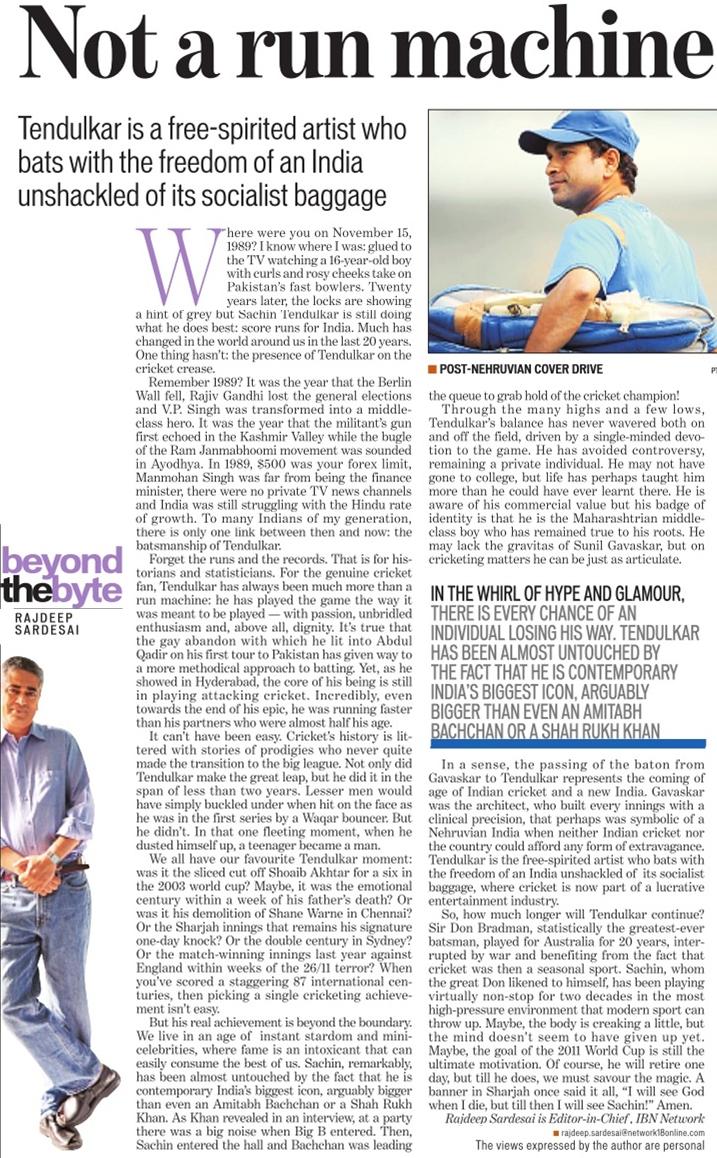
Where were you on November 15, 1989? I know where I was: glued to the television in my newspaper office watching a 16-year-old boy with curls and rosy cheeks take on Pakistan's fast bowlers. Twenty years later, the curly locks are showing a hint of grey but Sachin Tendulkar is still doing what he does best: score runs for India. Much has changed in the world around us in the last 20 years. One thing hasn't: the presence of Tendulkar on the cricket crease.
Remember 1989? It was the year that the Berlin Wall fell, symbolizing the end of communism. It was the year that Rajiv Gandhi was defeated in the general elections, as VP Singh was transformed into a middle class hero. It was the year that the militant's gun first echoed in the Kashmir valley while the bugle of the Ram Janmabhoomi movement was sounded in Ayodhya. In 1989, five hundred dollars remained your forex limit when travelling abroad, Dr Manmohan Singh was far from being the finance minister, there were no private television news channels and India was still struggling with the Hindu rate of growth. To many Indians of my generation, there is only one link between then and now: the batsmanship of Tendulkar.
Forget the mountain of runs and the gush of records. That is for historians and statisticians to archive for the future. For the genuine cricket fan, Tendulkar has always been much more than a run machine: he has played the game the way it was meant to be played, with passion, unbridled enthusiasm and, above all, dignity. It's true that the gay abandon with which he lit into an Abdul Qadir on his first tour to Pakistan has given way to a more methodical approach to batting. Yet, as he showed a few nights ago in Hyderabad, the core of his being is still in playing attacking cricket. Incredibly, even towards the end of his Hyderabad epic, he was running faster than his partners who were almost half his age.
Also read:
* Twenty years of Sachin Tendulkar
* Sachin Tendulkar: The early years
* Team-mates pay tribute to Tendulkar
* Tendulkar@20: Gavaskar pays tribute
It can't have been easy. Cricket's history is littered with stories of schoolboy prodigies who never quite made the transition from maidan cricket to the big league. Not only did Sachin make the great leap, but he did it in the span of less than two years. Lesser men would have simply buckled under when hit on the face as he was in the first series by a Waqar bouncer. But he didn't. In that one fleeting moment when he dusted himself up after the injury, a teenager became a man.
We all have our favourite Sachin moment: was it the sliced cut off Shoaib Akhtar for six in a famous run chase over Pakistan in the 2003 world cup? Maybe, it was the emotional century within a week of his father's death, a father who had been his role model? Or was it his demolition of Shane Warne in Chennai on a turning track? Or the Sharjah innings that remains his signature one day knocks? Or a monumental double century in Sydney? Or the match-winning innings last year against England within weeks of the 26/11 terror attack that appeared to miraculously lift the gloom? When you've scored a staggering 87 international centuries, then picking a single cricketing achievement isn't easy.
But his real achievement is beyond the boundary. We live in an age of instant stardom and mini-celebrities, where fame is an intoxicant that can easily consume the best of us. In the crazy whirl of hype and glamour, there is every chance of an individual losing his way. Sachin, remarkably, has been almost untouched by the fact that he is contemporary India's biggest icon, arguably bigger than even an Amitabh Bachchan or a Sharukh Khan. As Khan revealed in an interview, at a party of cricketers and film stars there was a big noise when Amitabh entered. Then, Sachin entered the hall and Amitabh was leading the queue to grab hold of the cricket champion!
Through the many highs and a few lows, Sachin has been calm and focussed. He has consciously avoided controversy, remaining an intensely private individual while displaying his talent to millions. He may not have gone to college, but life has perhaps taught him more than he could have ever learnt in the classroom. He is fully aware of his commercial value but his badge of identity is that he is the Maharashtrian middle class boy who has remained true to his roots. He may lack the gravitas of the original little master, Sunil Gavaskar, but on cricketing matters he can be just as articulate.
In a sense, the passing of the baton from Gavaskar to Tendulkar represents the coming of age of Indian cricket and a new India. Gavaskar was the architect, who built every innings with a clinical precision that perhaps was symbolic of a Nehruvian India when neither cricket nor the country could afford any form of extravagance. Tendulkar is the free-spirited artist who bats with the freedom of an India unshackled of its socialist baggage, where cricket is now part of a lucrative entertainment industry.
So, how much longer will Sachin continue? Sir Don Bradman, statistically the greatest ever batsman, played for Australia for 20 years, interrupted by war and benefiting from the fact that cricket was then a seasonal sport. Sachin, whom the great Don likened to himself, has been playing virtually non-stop for two decades in the most high-pressure environment that modern sport can throw up. Maybe, the body is creaking a little, but the mind doesn't seem to have given up yet. Maybe, the goal of the 2011 World Cup is still the ultimate motivation. Of course, he will retire one day, but till he does, we must savour the magic. A banner in Sharjah once said it all, "I will see God when I die, but till then I will see Sachin!" Amen.
Sachin: Solid as Sunny, ruthless as Richards
It's been 20 years since Sachin Tendulkar made his debut for India, but the desire and hunger to keep performing hasn't diminished one bit. What keeps him going? Who are his heroes? Where does the motivation come from?
"I don't need anyone to come to me or motivate me or prepare me before a big game," Tendulkar said in an exclusive interview. "I've always been motivated and I love this sport. I grew up loving this sport and as each day goes by, I fall in love with this game more and more.
Tendulkar said he continues to play because he remains motivated."The desire to go out there and win matches for my nation is growing, and it continues to grow," he said. "I'm proud of the fact that I've been able to play for 20 years and I'm still motivated, and I still want to go out there and do better."
Tendulkar revealed that his batting style was a "lethal combination" of the solidity of Sunil Gavaskar and the fierce strokeplay of Sir Viv Richards.
"Sunil Gavaskar, needless to say, and Vivian Richards are the batsmen that really inspired me," he said. "I wanted to be as solid as Sunil Gavaskar and as destructive as Vivian Richards, because that combination was always going to be lethal. I felt truly inspired by these two individuals on the field."
Tendulkar traced his insatiable appetite for runs to his formative years.
"If I scored a hundred in a school match, I would start thinking about how I could go a step further in the next match, get 150 runs. But if I failed, that would give me sleepless nights," he added.
The master batsman owed his success just as much to his team-mates, and said how important working as a team was to him.
"Team work for me is practising together and also trying to get the best out of each other," he said. "That can only happen if you go out of your way to help your team-mate. You must be prepared to sacrifice for your team-mate, which will eventually end up giving a positive result for your team."
CNN-IBN Interview
New Delhi: It was the winter of 1989 when a 16-year old Sachin Tendulkar made his debut for India against Pakistan, their fiercest rival. He came armed with an already formidable reputation and began the journey that scaled a summit that a few would imagine was possible.
Twenty years later, Sachin Tendulkar is a legend among his peers and a colossal that history would place on a heady pedestal. He still plays the game with limitless enthusiasm and continues to enchant.
CNN-IBN brings you the man himself, his unmatched success and the hunger that continues to drive him on in Tendulkar@20 in his own words.
CNN-IBN: Are you still as excited as ever to begin a new season of cricket?
Sachin Tendulkar: I am always excited to play cricket. Twenty years ago, it was a similar kind of excitement and today also it's the same. When it's cricket, the heart starts beating faster and it's not just me, but everyone around us. They all are looking forward to the season and so am I.
CNN-IBN: As you said, as the season starts, the heart starts beating faster but now you must know how to deal with the positive nervous energy in a much better way than when you were 16.
Sachin Tendulkar: Initially, I didn't realise this but as time went by I came to know that this is how my body gears up before a big game. I am a little restless and that's how my body is preparing and my subconscious mind is getting ready for the event. Now I am used to it. So I like it when I am a little restless. I'm comfortable with it.
CNN-IBN: Have you redefined the word genius? In two months time, you will become the second cricketer to complete two decades in international cricket. How do you look back at this entire journey?
Sachin Tendulkar: It's been a fantastic journey. I thoroughly enjoyed it and every moment has been a special one. Playing for India means the world to me. I grew up dreaming about playing for India and I am living my dream. It's almost going to be 20 years now.
I am thankful to God that I have been given the opportunity to play for the country for such a long period. I have been fortunate because so many people dream of playing for the nation and I have been doing it for a couple of decades. So I am quite happy about it.
CNN-IBN: You have broken almost all records a batsman can. So now what motivates you personally, apart from the team goals like winning a World Cup for India? Do you aspire to get 15, 000 runs or hundred centuries?
Sachin Tendulkar: First of all, when you play for India, you do not need any external factor to motivate you. When you play for India, you are motivated from within. I don't think anybody plays for the records. Records are just mere reflection of what I have been able to do for the country. It's just my contribution.
While playing, if records are broken, it's great. But what we look to do is go step by step towards achieving the team's target. And while achieving that the various things that happen are always welcomed. The most important thing is the team's glory and that's what we all focus on.
CNN-IBN: But someone as Roger Federer aims to have this many grand slam titles. Do you see yourself achieving 15, 000 runs? Is it something you are looking to achieve?
Sachin Tendulkar: I have never said I want to score 15,000 runs. When I achieved 10,000 runs Sunil Gavaskar said to me that I should achieve 15,000. And that was what I was asked and I answered that if my hero tells me to do something, I have to put a big effort to do that. And that is where it ended.
It was projected differently. I have never made such big statements. I would like to enjoy the game. And if it has to happen, it will happen.
The only target that I can say I was given was 35 Test hundreds because we grew up watching Sunil Gavaskar and every now and then his examples were used. And if you wanted to be regarded as one of the greatest players, then you have to get to 34 hundreds and go past that. That was the target. I am quite happy because Gavaskar played a role in motivating all of us and left such a legacy that the next generation got inspired by what he did. And in every step in our cricketing life, we have used his example.
CNN-IBN: Gavaskar was a hero for you, Rahul and Sourav. But now you are the hero for the next generation. Piyush Chawla was born in the same year you made your debut. So what do you think you have given to the art of Indian batting?
Sachin Tendulkar: I don't know. I guess I am the wrong person to ask this question. I have just gone ahead and expressed myself. I have just played the game I know and I have been taught. And if the kids watching me got inspired then I think it's for them to answer this question. You can ask them what were the qualities they liked and what were the factors that motivated them.
For me I can say that winning the 1983 World Cup was a huge thing and again the victory in Australia in 1985 when Ravi Shastri became the champion of the champions played a huge role in motivating me and making me feel that one day I have to be a part of this team. So I will leave the question you asked for the youngsters to answer.
CNN-IBN: Do you think you brought a Viv Richards style batting to India, one which is aggressive?
Sachin Tendulkar: My two batting heroes have always been Gavaskar and Viv Richards and I have always felt that I should be a mixture of both. When it comes to attacking, I should be able to play shots like Richards and when it comes to concentration, mental toughness, determination and guts, I should be Gavaskar. I grew up watching them and wanted to play like them. And also, achieve what they have been able to for their countries.
CNN-IBN: Sir Don Bradman said you bat like him. That's not a small compliment. Do you feel there is any young cricketer who plays like you?
Sachin Tendulkar: The statement from Sir Don was a huge thing for me. I remember I was in Sharjah and I was told that this is what Sir Don said about you and I was on top of the world. I was extremely happy and I didn't know how to react. Then I got the opportunity to meet him on his 90th birthday. I spent an hour with me, which is always going to be the highlight of my life.
If I have to describe somebody who comes closest to my batting style, it has to be Virender Sehwag. Even at home, people get confused as to who is batting because the attire is almost the same after he started wearing those leg-guards.
CNN-IBN: There is a massive book coming on you called the Sachin Tendulkar opus. Now when we saw the list institutes on which the books have been written. It's Manchester United, Wimbledon, Formula One, Maradona and Mohammad Ali. Where do you see your name on that list?
Sachin Tendulkar: I see myself somewhere there. It's a huge book. I have got Mohammad Ali's book at home. It weighs 35 kilos and is a pictorial book. It's like watching a movie with some exclusive pictures and you won't get to see anywhere else. And I can vouch for that because I have seen couple of Mohammad Ali's pictures in that book that I have not seen anywhere else.
It's very exclusive and the moment I saw the copy, I said that yes I will do it because this is something exciting and special. I have never seen anything like this before. Can you imagine a book weighing 35 kilos? It's something unique.
CNN-IBN: People now don't compare you with great batsmen. They compare you with great sportsmen like Roger Federer and Tiger Woods. How does it feel when you are compared with global sportsmen?
Sachin Tendulkar: It feels good when you are contributions are acknowledged. Who doesn't like being praised?
CNN-IBN: When you look at these sporting greats, whose personality do you think comes closest to yours?
Sachin Tendulkar: I think there is something wrong with me because my sporting hero has always been outside cricket and it has always been John McEnroe. I like his style and his aggression and he always expressed himself. I liked his mannerisms and there was something that caught my eye at the age of five or six when I started watching him. I was the only one who used to support McEnroe and the rest of the guys used to back Bjon Borg. I also like Boris Becker, Pete Sampras and Roger Federer. I watch a lot of tennis. And I also watch Formula One and Michael Schumacher.
CNN-IBN: The opus contains your entire life story. Would you want to be the last picture in that book to be you holding the 2011 World Cup?
Sachin Tendulkar: It's just not my dream. It's the entire nation's dream. To win the World Cup is a huge achievement and as a cricketer you want to do that for your nation. And same here, I would like to do that.
CNN-IBN: We recently saw Australia toppled over as the number one team. Do you think the Australian domination is over?
Sachin Tendulkar: Australia definitely lost a lot of match-winning players and I felt they left a vacuum. But that does not mean that they cannot fill that up and get back to the top sides of the world. It's still one of the top sides of the world. South Africa have played really well for a couple of years and have shown a lot of consistency. Australia will be there and it's just a cycle and every team has to go through that cycle. I feel Australia will get there at one stage.
CNN-IBN: Do you think India have the potential to be the number one side?
Sachin Tendulkar: We have the ability, spirit, desire and the hunger to get there. We have been working towards it. I know it has been a roller coaster ride. If you look at our performance in the last couple of years, it has been terrific. And a couple of hiccups here and there are always going to be there. It's never going to be smooth ride. And that's what keeps us together and tighter. It's the difficult times when the team needs to be closer and rise up to the challenges and meet the obstacles. I see good times ahead of us.
We have had some terrific times in the past and we will likely to continue that. We have our team target and we want to achieve that.
CNN-IBN: When you see the world of cricket today, do you feel the Test cricket is in danger?
Sachin Tendulkar: No, I have no fears. I don't think Test cricket is in any danger. It is very much safe. It's the ultimate test of a player's character, his peripheral awareness and vision. You should be able to realise playing on the second day what the wicket will play out in the fifth day. That planning is important. So, Test cricket is the most challenging format. I don't think there is any danger to Test cricket.
CNN-IBN: Do you think there should be any changes done in the format of Test cricket?
Sachin Tendulkar: I don't think any changes are needed because most of the Test matches are producing results. Earlier, there were complaints that most of the matches are drawn and there are no results. But we are consistently getting results. So where is the problem? It's a different format of the game. It's the most challenging format of the game. So appreciate it rather than finding faults with it. Just because there are a couple of new introductions, doesn't mean Test cricket has to change.
CNN-IBN: For someone who has broken all ODI records and has played the maximum number of ODIs, how do you see the future of ODI cricket?
Sachin Tendulkar: I do feel there can be subtle change to ODIs. This thing has been going on for some time and I have been thinking about it. Why not make a side bat for 25 overs and then make the other side bat. There is an unfair advantage. If it's a day/night game, sides know that there will dew under the lights and both will like to bowl first and then 300 becomes a chaseable target.
So play 25-25 innings; so that both sides bat and bowl when there is due. And if it's a day game and there is dampness in the wicket then both sides get to play on a wicket that does a bit initially. That will bring balance to the game.
I remember this thought came to my mind in 2002 when we were playing Champions Trophy in Sri Lanka. We played two days and still there was no result. We were declared joint winners. But we had played almost 110 overs. The first day, Sri Lanka batted 50 overs and then we batted for seven-eight overs. The next day again Sri Lanka batted 50 overs before it was rained off. So we played 110 overs and there was no result. If you play 25 overs each then at least at the end of 40 overs or 50 overs, you know a particular side has won that game.
CNN-IBN: Do you think with IPL, a hype has been added to cricket that can mislead the young players and make them look at cricket in a wrong way?
Sachin Tendulkar: Times have definitely changed. There is no doubt about it. But getting distracted and losing your focus is up to the individual. A lot of things may be happening around you, but you have to keep your focus and composure. You need to know your priorities.
When I was growing up, playing cricket was the ultimate thing. I didn't care about anything else. I just wanted to score as many runs and win matches. It was that simple. The rest of the things take care of themselves. You just need to worry about cricket rather than doing various things around cricket. Cricket should be in the foreground and the rest has to be in the background.
CNN-IBN: How do you ensure that a cricketer gets to know what Test cricket is like so that he develops a technique built to tackle a hard day of cricket at the highest level?
Sachin Tendulkar: I think we need to be realistic here. Not everyone can play Test cricket for their country. But with IPL, there are eight teams and so many players are getting the opportunity, which is good for cricket and good for the individuals.
And I support that because there are so many players who have played Ranji Trophy for their states and have struggled to take care of their families because the income was not much. But now with the IPL, the income is substantial.
You play cricket because you are passionate about it and this is a different format. For guys who know somewhere in their hearts that I may not play Test cricket for India, this is not a bad option because you get to enjoy cricket and you can look after your families. And there is nothing wrong with it. It is extremely important to look after your family and as I said, the times have changed and we need to change with that.
This is just a different format of the game and don't mix two things. Twenty20, one-day and Tests are different formats of the game. And whoever is good, and has the desire to play for India, will always focus on the five-day version, not on the Twenty20. So, it is up to the individual also.
CNN-IBN: What's the secret behind your focus and dedication?
Sachin Tendulkar: It was not difficult to stay motivated. It was difficult to keep scoring runs because every day is a different day, every bowling attack is different and every surface is different. Sometimes your footwork is good, sometimes your hands are going correctly towards the ball, sometimes you are thinking right but that's not how you will feel every day. But every day, you are motivated to do well for India. And that is why I care about cricket. If you care about cricket, the rest will follow.
At home, there is an unwritten law that if I do well and records are broken, we just distribute sweets at home and keep a box of sweets in front of God and move on. Let the others talk about what I have achieved and we focus on the next game. Right from my school days, we have followed that and that works even today.
I have always been able to keep things simple because my family has played a huge role. My wife, my brother Ajit, my mother, my other brother Nitin, his wife, my uncle and aunt whom I stayed with, my coach and everybody; it's a huge army that goes with me. I represent them in the middle but it is a huge team that works together.
And last but not the least, my father who played a huge role in this.
CNN-IBN: Do you get irritated when people keep asking about your retirement plans?
Sachin Tendulkar: No, I don't get irritated. I have been asked this question a lot of times. I feel it is my decision. I know that I know my body better than somebody else. I understand the frame of my mind. The day I feel I am not feeling motivated to get on to the field. I will have a closer look at the whole issue. If that continues, then I will know I need to move away. I am enjoying every moment and when the time comes, we will deal with it.
CNN-IBN: Do long breaks help you?
Sachin Tendulkar: A break does help because after a long season one needs a long break. You need to recharge your batteries. You also allow your body to rest a bit and then again start fresh. When you start out, you just want to pick a bat and go to the field. But it's not the same when you get up in the morning and go to the nets and face 150 balls and then come back to your hotel room.
I think it's very important to spend time with your family. I managed to do that this time. And I had quality time, so now I am looking forward to the next season. So I think there has to be balance. And as long as you find the right balance, it works.
CNN-IBN: Now that you are a father, what kind of dreams do you have for your kids? Do you see a blur picture of Arjun at 17 or 18 playing for India?
Sachin Tendulkar: When I dream, I make sure I dream twice. One is my dream as a cricketer and the other for my family. The cricketing dream stays the same.
I have left that to him. He has started playing cricket and my daughter plays tennis. I don't want to force them into cricket or tennis. It has to come from their side. I would just give them directions. Eventually, it's their life and my job is to guide them.
CNN-IBN: Have your kids realised that they stay with one of India's biggest heroes?
Sachin Tendulkar: I am just their father. That's where it stops. I am all those other things when I cross the ropes in a cricket field. Otherwise I am a family man and now they know that I play cricket for India.
It was tough initially because my son did not like it when I left home. For the first five-six years of his life, he did not speak to me on the phone. That was difficult for me but now he knows what I do and he appreciates that; so that's nice.
CNN-IBN: Where would you like to see the Indian team after the end of the big season ahead?
Sachin Tendulkar: It's going to be a challenging season. I wish we were playing more Test cricket. We play only three Tests in the season but the calendar is such that we cannot accommodate more matches. And whatever has come in our share, we will like to make the most of it. I hope we live up to the expectations of the nation and get to where we as a team have targetted. That obviously stays in the dressing room that our targets are. But it is obvious that we want to be there at the top. So we will just go out there and give our best.
CNN-IBN: Has anyone in the dressing room ever called you - uncle?
Sachin Tendulkar: Well, don't give them ideas.
Friday, November 20, 2009
Tendulkar is beyond compare: Gavaskar

Sachin Tendulkar has managed an achievement beyond compare by completing 20 years in international cricket, feels Sunil Gavaskar, who considers the veteran right-hander the greatest batsman that the game has seen.
"I think, apart from Sir Garfield Sobers nobody else has played 20 years in international cricket and 20 years playing at the very highest level and to the very highest standard is an achievement beyond compare," Gavaskar said of the 36-year-old, who completed his two decades in international cricket today.
"No place can be too high for this young man and he is young because as far as his enthusiasm for the game is concerned, he is almost childlike. That is what is keeping him going on and on," he told 'CNN-IBN'.
Gavaskar, himself a celebrated batsman of his era, said he started understanding cricket only post 1960 and is yet to see a batsman as complete as Tendulkar.
"Since 1960, from when I started to understand a little bit of cricket, he has been the greatest batsman that the game has seen," he said.
Subscribe to:
Posts (Atom)